Built for the way your line actually runs.
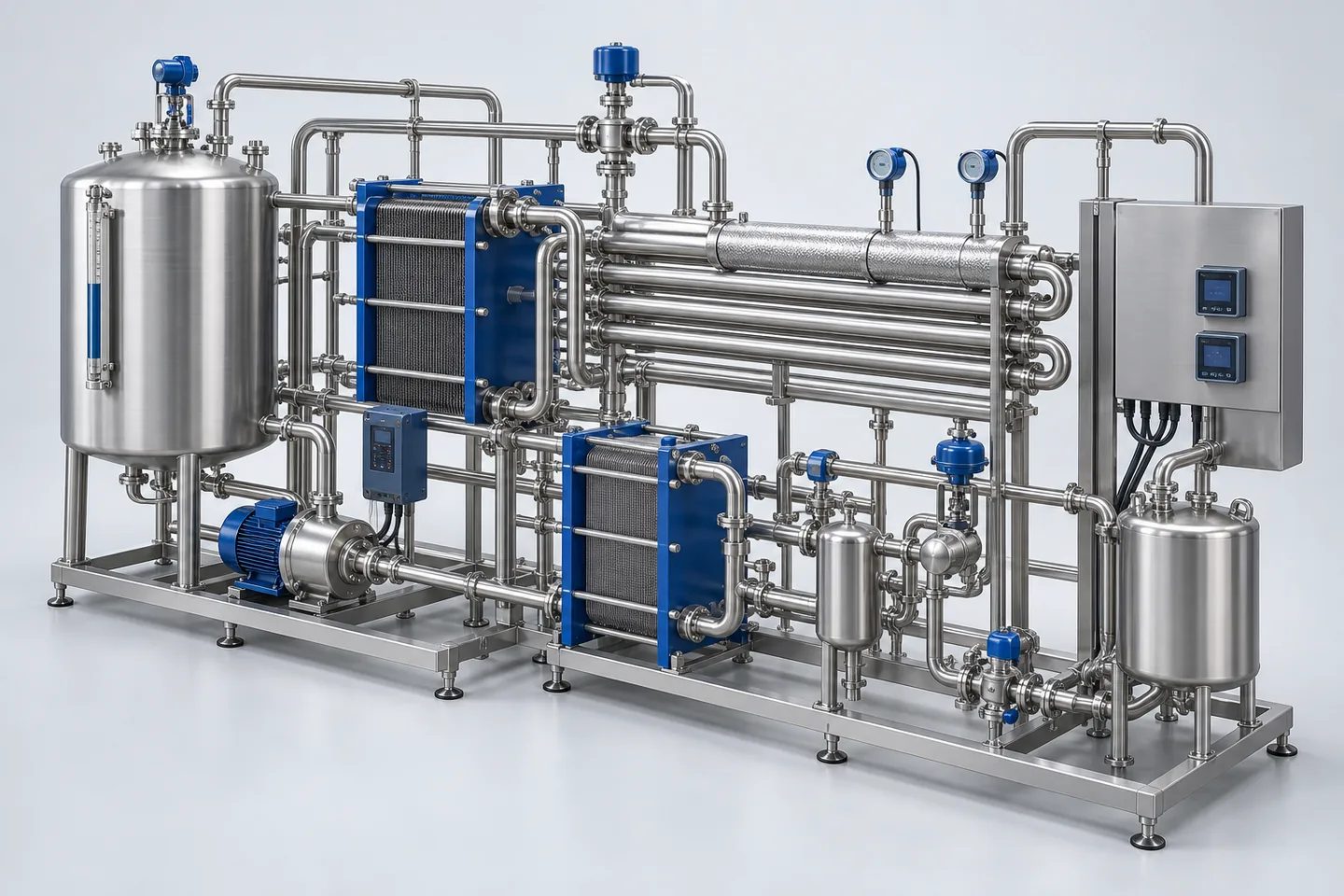
HTST tubular and plate heat exchanger pasteurisers with holding tubes, regeneration sections and automatic flow diversion, for juice, nectar, RTD tea, dairy beverages and flavoured water.
Pasteurisation is where beverage shelf life is actually created, and where most shelf-life failures originate. The two variables that matter are temperature and time — and time means residence in a correctly sized holding tube, not a number on a display. Our units include a calculated hold tube, dual temperature probes, and an automatic flow diversion valve that returns under-temperature product to the balance tank instead of sending it to the filler. Plate exchangers are used for low-viscosity clear products where regeneration efficiency matters; tubular units handle pulp, fibre and higher viscosity without blocking.
Who this configuration suits.
Get a detailed quote for the Pasteuriser.
Layout drawing, utility schedule, BIS / FSSAI checklist, itemised quotation in 24 hours.
Everything we ship with this plant.
Standard turnkey scope. Optional add-ons quoted on request.
Specs at a glance.
| Capacity | 500 – 20,000 litres/hour |
| Type | Tubular (pulp / viscous) or plate (clear / low viscosity) |
| Temperature range | 65 – 138°C |
| Hold time | 15 s – 60 s, calculated per product |
| Regeneration | Up to 90% (plate configuration) |
| Safety | Automatic flow diversion on under-temperature |
| Wetted parts | SS-316L |
| Recording | Paperless recorder with batch traceability |
Price on Request.
Every plant is quoted against your capacity, feedwater analysis, plot and product mix. Send us those and you get an itemised proposal within 24 hours.
Output, degree of automation and whether you need redundancy on critical stations.
A high-TDS, iron-heavy or seasonal input changes the treatment train and its cost materially.
Machinery only, or turnkey with civil drawings, utilities, commissioning and BIS / FSSAI documentation.
Number of SKUs, bottle sizes and how fast you need to switch between them.
Common questions.
Tubular or plate pasteuriser?+
Tubular for anything with pulp, fibre or particulates, and for high-viscosity product — plates block. Plate for clear juices, flavoured water and RTD tea, where the higher regeneration efficiency cuts steam and chilling cost substantially.
Why is a flow diversion valve important?+
Because under-temperature product will otherwise reach your filler and be packed. Diversion is the difference between a process that guarantees pasteurisation and one that merely usually achieves it — and it is what an FSSAI or buyer audit will look for.