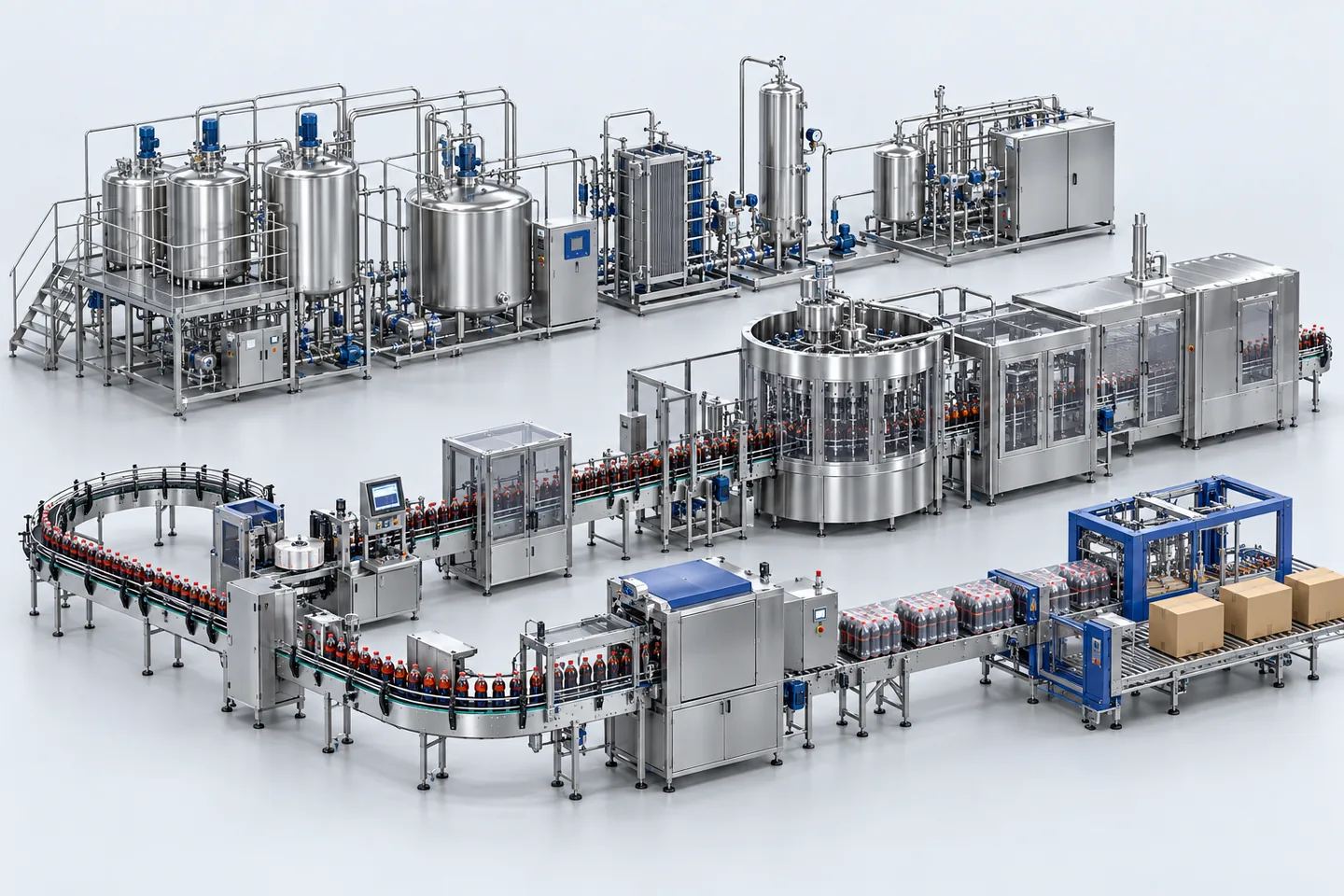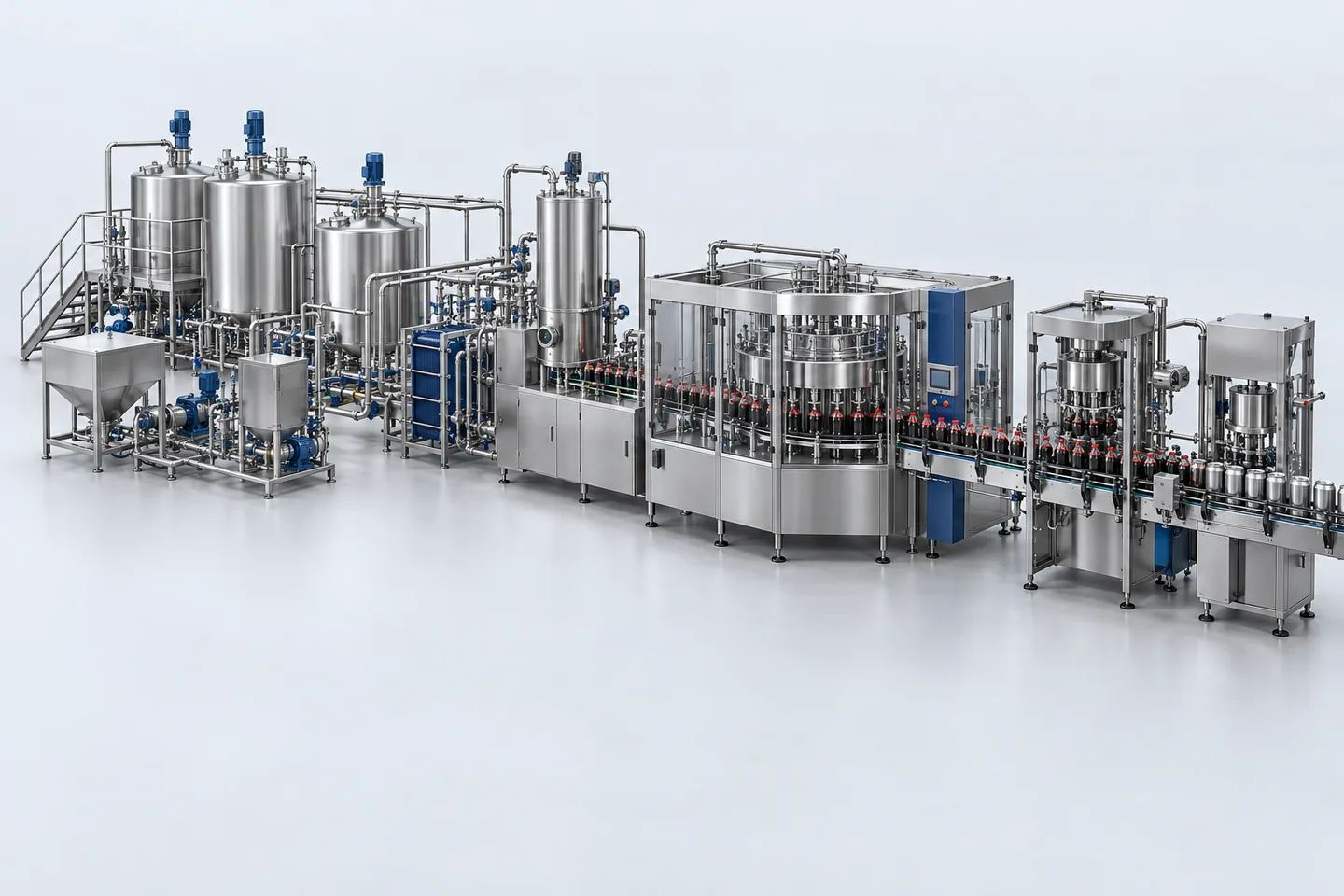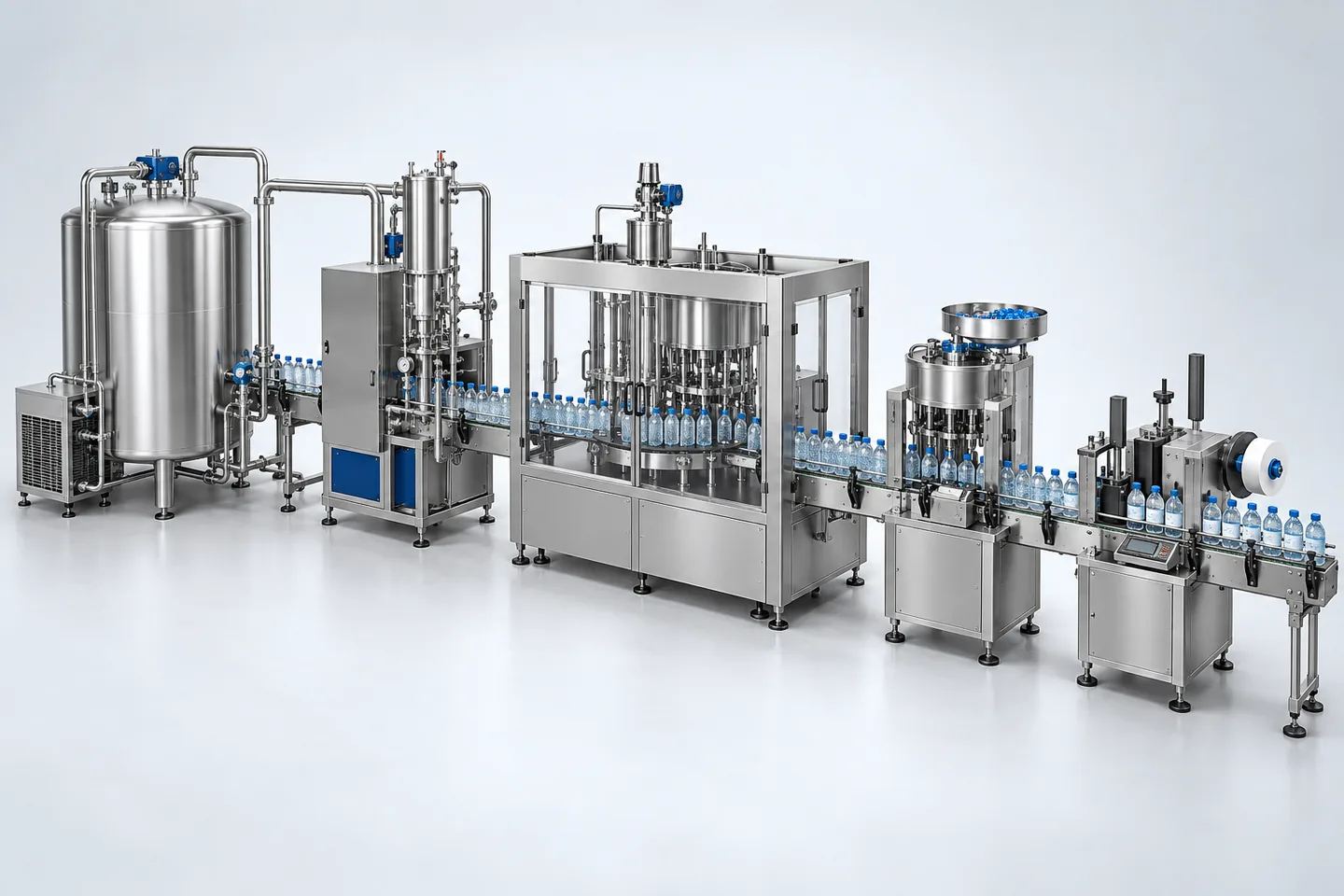
Built for the way your line actually runs.
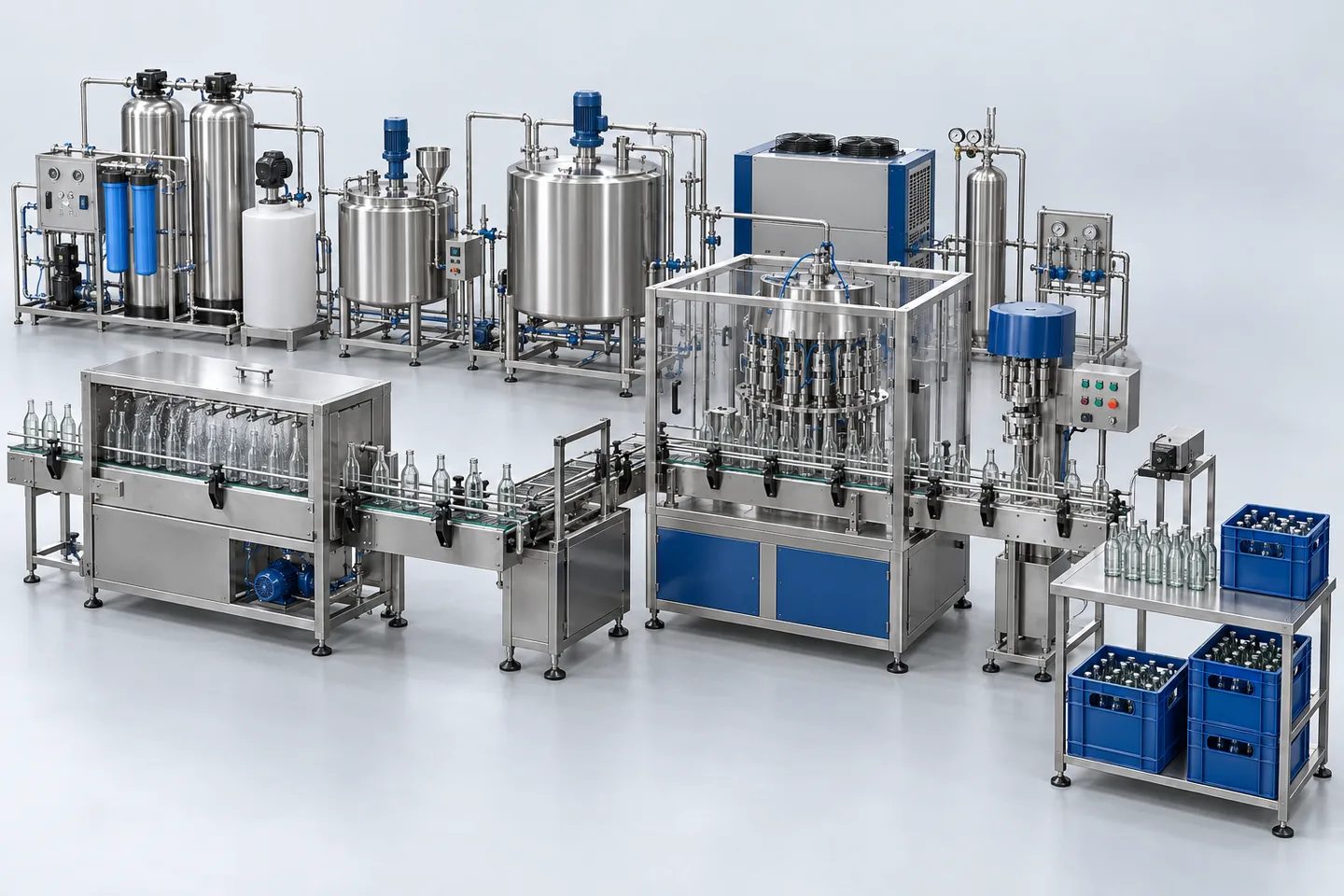
A semi-automatic soda water and soft drink plant with a compact carbonator, 4–8 head counter-pressure filler and crown or ROPP capping, for local and district-level brands.
Not every soft drink business needs a rotary CSD line. District brands, returnable-glass soda operators and seasonal bottlers can run profitably on a semi-automatic block that costs a fraction of a full plant. The configuration is honest about its limits: output is around 20 BPM, changeover is manual, and the operator controls carbonation set points rather than a PLC recipe. What it does provide is real counter-pressure filling — not the gravity filling some cheap "soda machines" use, which cannot hold carbonation in the bottle. It also uses the same carbo-cooler and syrup blending principles as our larger plants, so the product quality is genuinely comparable at lower speed.
Who this configuration suits.
Get a detailed quote for the Small Soda Plant.
Layout drawing, utility schedule, BIS / FSSAI checklist, itemised quotation in 24 hours.
Everything we ship with this plant.
Standard turnkey scope. Optional add-ons quoted on request.
Specs at a glance.
| Output | 20 BPM (1,200 BPH) approx. |
| Carbonation | 2.5 – 4.0 volumes CO₂ |
| Filling type | Counter-pressure (isobaric), semi-automatic |
| Pack formats | 200ml, 300ml returnable glass or 250–600ml PET |
| Power load | 15–25 kW |
| Footprint | 1,200–2,000 sq.ft. |
| Manpower | 5–7 per shift |
| Upgrade path | Water house and syrup room carry into a 60 BPM line |
What does a small soda plant cost?
A Semi-Automatic Small-Scale Soda Plant costs ₹15–30 lakh turnkey, ~20 BPM in India as an indicative range. Final pricing depends on your feedwater analysis, whether the scope is turnkey or machinery-only, your SKU mix and the utilities already on site.
Indicative market range for a turnkey line, not a quotation. The figure moves with feedwater quality, whether the scope is machinery-only or turnkey, how many SKUs you run and what utilities already exist on site.
Output, degree of automation and whether you need redundancy on critical stations.
A high-TDS, iron-heavy or seasonal input changes the treatment train and its cost materially.
Machinery only, or turnkey with civil drawings, utilities, commissioning and BIS / FSSAI documentation.
Number of SKUs, bottle sizes and how fast you need to switch between them.
Common questions.
Can a semi-automatic plant hold proper carbonation?+
Yes, provided it uses counter-pressure filling. Machines that gravity-fill carbonated product lose CO₂ during filling and produce flat drinks. Counter-pressure filling is the non-negotiable part of the specification at any speed.
What is the realistic daily output?+
At 20 BPM and 70% practical efficiency, expect 7,000–8,000 bottles per 8-hour shift with a trained crew. Returnable glass runs slower because of washing and inspection.