RTS Juice Manufacturing Process: Every Step from Pulp to Palletised Carton
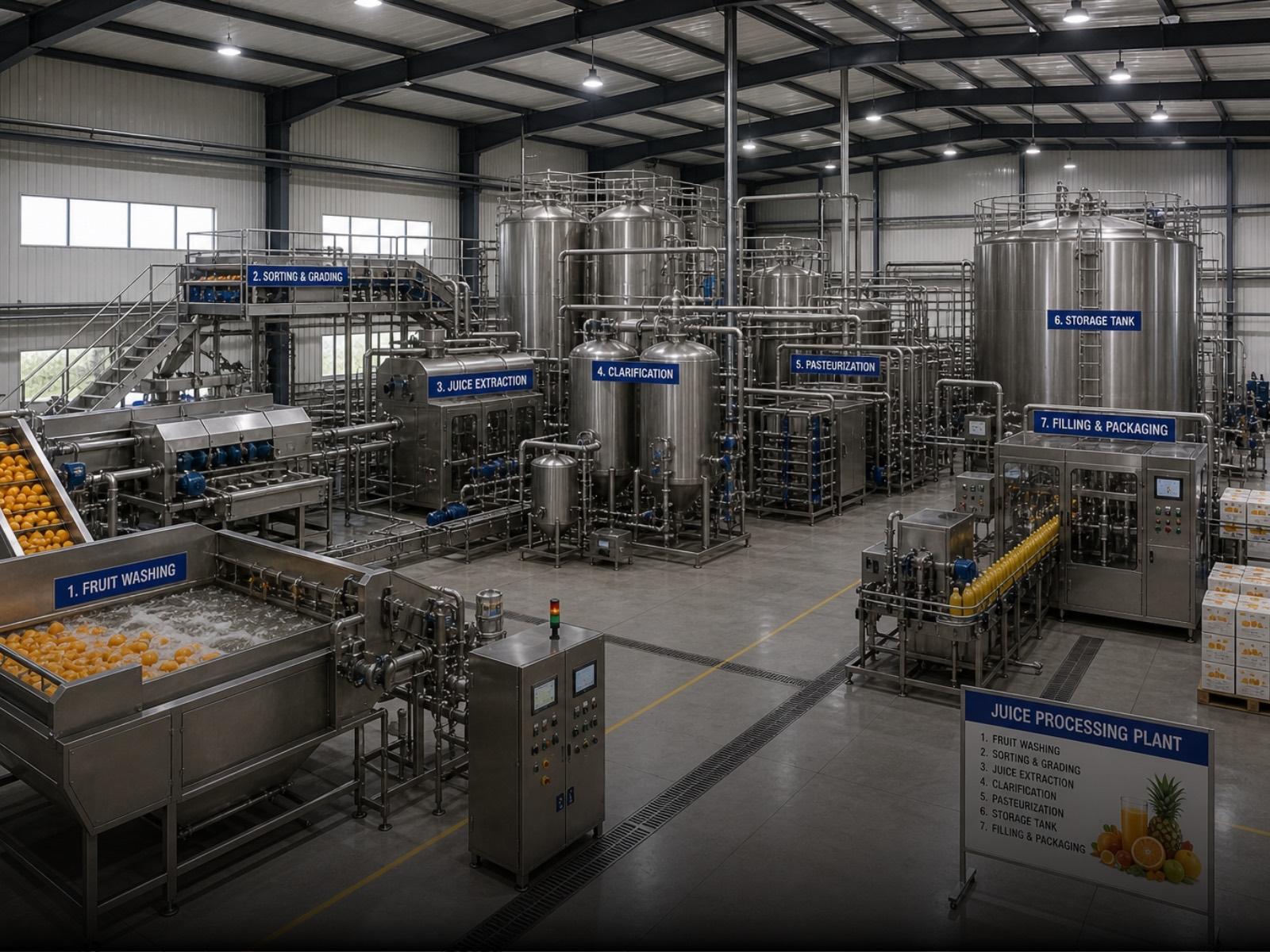
What RTS means, and why it decides your plant
RTS stands for Ready To Serve: a fruit drink at roughly 10 to 15 percent fruit content, sweetened, and drunk without dilution. It is the largest juice category in India by volume and the one most regional brands compete in. It is not 100 percent juice, it is not nectar at 20 to 50 percent fruit, and it is not squash, which the consumer dilutes.
That definition is not marketing — it is a regulatory line. FSSAI fruit-content thresholds decide what you may legally print on the label, and the threshold you are targeting determines your blending ratios, your syrup room capacity and your raw material cost per litre. Decide the category before you specify the plant, because a line built for RTS economics and a line built for 100 percent juice are different machines.
| Category | Typical fruit content | What the consumer does |
|---|---|---|
| RTS fruit drink | 10 - 15% | Drinks it as is |
| Nectar | 20 - 50% | Drinks it as is |
| 100% juice | 100% | Drinks it as is |
| Squash / sharbat | Concentrated | Dilutes before drinking |
The process, stage by stage
1. Raw material intake
Two routes, and this is the first of the two decisions that shape the whole project.
Aseptic pulp arrives in sterile bags in drums, stores at ambient, and lasts a year. You reconstitute it when you need it. This is what most successful RTS brands run on, because it turns a six-week mango harvest into a twelve-month business and removes the entire fruit-handling section of the plant.
Whole fruit means washing, sorting, destoning, pulping and finishing on site. It gives you control of the pulp and can be cheaper per litre in season, but it adds a large civil footprint, a seasonal labour peak, and equipment that sits idle for ten months of the year.
For a first plant, aseptic pulp is almost always the right answer. Whole-fruit intake makes sense when you have a reliable local supply, the volume to justify the line, and a commercial reason to control the pulp yourself.
2. Syrup room
Sugar is dissolved, treated with activated carbon where colour demands it, filtered, and held as a standardised syrup at a known Brix. This is the heart of consistency: if your syrup Brix drifts, every batch downstream drifts with it.
Inline Brix measurement pays for itself here. Batch-to-batch variation in sweetness is one of the fastest ways to lose a regional brand's repeat customers, and it is invisible until a distributor complains.
3. Blending and standardisation
Pulp, syrup, treated water, acidulant (usually citric acid), preservative within FSSAI limits, colour and flavour are proportioned to the recipe. The targets are Brix, acidity and the Brix-to-acid ratio — that ratio, more than sweetness alone, is what people taste as balance.
Recipe-driven proportioning costs more than batch blending but holds tolerance better across a shift. On a multi-SKU line it usually justifies itself within the first year.
4. Homogenisation
Where pulp content is meaningful, a high-pressure homogeniser breaks particles down so they stay suspended. Skip it and you get separation on the shelf — a clear layer at the top of the bottle two weeks after dispatch. That reads as a quality failure to a consumer even though the product is perfectly safe.
5. Pasteurisation
Heat treatment to a validated time-temperature combination, sized against your product's pH and the spoilage organisms that matter for it. Tubular or plate, depending on viscosity and pulp content.
This stage is where a plant either has a defensible shelf life or does not. Get the validation documented, because it is what FSSAI and any serious modern-trade buyer will ask to see.
6. Filling — the second decision
| Hot-fill | Aseptic | |
|---|---|---|
| Fill temperature | 85 - 92 degrees C | Ambient, sterile zone |
| Bottle | Heat-resistant PET, heavier | Standard PET, lighter |
| Colour and flavour retention | Good | Better |
| Indicative turnkey cost | Rs 1.1 - 2.2 crore | Rs 2.5 - 5 crore |
| Right for | Most new RTS brands | Scale, premium, carton formats |
Hot-fill fills hot into heat-resistant PET, then inverts the bottle so the hot product sterilises the closure, then cools. It is simpler, cheaper and thoroughly proven for RTS.
Aseptic sterilises product and package separately and fills cold in a sterile zone. It protects colour and flavour better and allows a lighter bottle, but roughly doubles the capital.
For a brand entering the market, hot-fill is the right first line. Aseptic is a scale decision, not a starting decision.
7. Capping, cooling and inversion
On a hot-fill line the sequence matters: cap, invert to hold the closure at temperature for a validated dwell, then cool in a controlled tunnel. Cool too fast and you risk panelling the bottle; cool too slowly and you cook the flavour you just worked to protect.
8. Labelling, coding, packing
Labelling, batch and date coding, shrink or carton packing, palletising. Standard end-of-line, but the coder matters more here than on water: traceability to batch is a recall requirement, not a convenience.
CIP, which is not optional
Juice fouls equipment in a way water does not — sugar and pulp both. A validated multi-circuit clean-in-place system is part of the plant, not an accessory. Plan CIP time into your capacity maths: a line rated at 60 BPM that needs ninety minutes of CIP a day is not a 60 BPM line for eight hours.
This is the single most common reason a juice plant under-delivers against its project report. Plan on 55 to 65 percent of rated capacity in year one, not the 85 to 90 percent optimistic projections use.
What the whole line costs
| Configuration | Indicative turnkey |
|---|---|
| Squash, syrup and sharbat line | Rs 18 - 45 lakh |
| Amla and aloe vera juice line | Rs 40 - 95 lakh |
| Lemonade, shikanji and nimbu pani | Rs 45 - 90 lakh |
| Sugarcane juice line, incl. cane handling | Rs 90 lakh - 2.2 crore |
| Hot-fill RTS bottling plant | Rs 1.1 - 2.2 crore |
| Turnkey juice processing plant | Rs 1.1 - 3.5 crore |
| Mango juice processing plant | Rs 1.2 - 3 crore |
| Aseptic juice bottling plant | Rs 2.5 - 5 crore |
Full breakdown on the juice plant cost page.
FAQ
What is the RTS juice manufacturing process?
Pulp intake or reconstitution, syrup preparation, blending and standardisation to target Brix and acidity, homogenisation where pulp content requires it, pasteurisation to a validated time-temperature, filling by hot-fill or aseptic, capping with inversion on hot-fill lines, controlled cooling, then labelling, coding and packing. CIP runs between product changes and at end of shift.
What is RTS juice?
RTS means Ready To Serve — a fruit drink at roughly 10 to 15 percent fruit content, sweetened and drunk without dilution. It is the largest juice category in India by volume. It differs from nectar at 20 to 50 percent fruit, from 100 percent juice, and from squash, which is concentrated and diluted by the consumer.
Should I use fresh fruit or aseptic pulp?
Aseptic pulp for most first plants. It turns a six-week harvest into a twelve-month business, removes the washing, sorting, destoning and pulping section entirely, and cuts both capital and civil footprint substantially. Whole fruit makes sense when you have reliable local supply, the volume to justify the line, and a reason to control pulp quality yourself.
What is the difference between hot-fill and aseptic juice bottling?
Hot-fill pasteurises the juice and fills it at 85 to 92 degrees C into heat-resistant PET, then inverts to sterilise the closure and cools. Aseptic sterilises product and package separately and fills cold in a sterile zone. Aseptic protects colour and flavour better and allows lighter bottles, but roughly doubles the capital — Rs 2.5-5 crore against Rs 1.1-2.2 crore for hot-fill.
Why does my juice separate in the bottle?
Almost always insufficient homogenisation for the pulp content in the recipe. A high-pressure homogeniser breaks pulp particles down so they stay suspended through shelf life. Without it, a clear layer forms at the top of the bottle within a couple of weeks, which consumers read as spoilage even though the product is safe.
---
We build RTS juice plants from 30 BPM to 400+ BPM, automatic and semi-automatic. See the range, what it costs, or send us your fruit and target capacity for a quotation in 24 hours.