Built for the way your line actually runs.
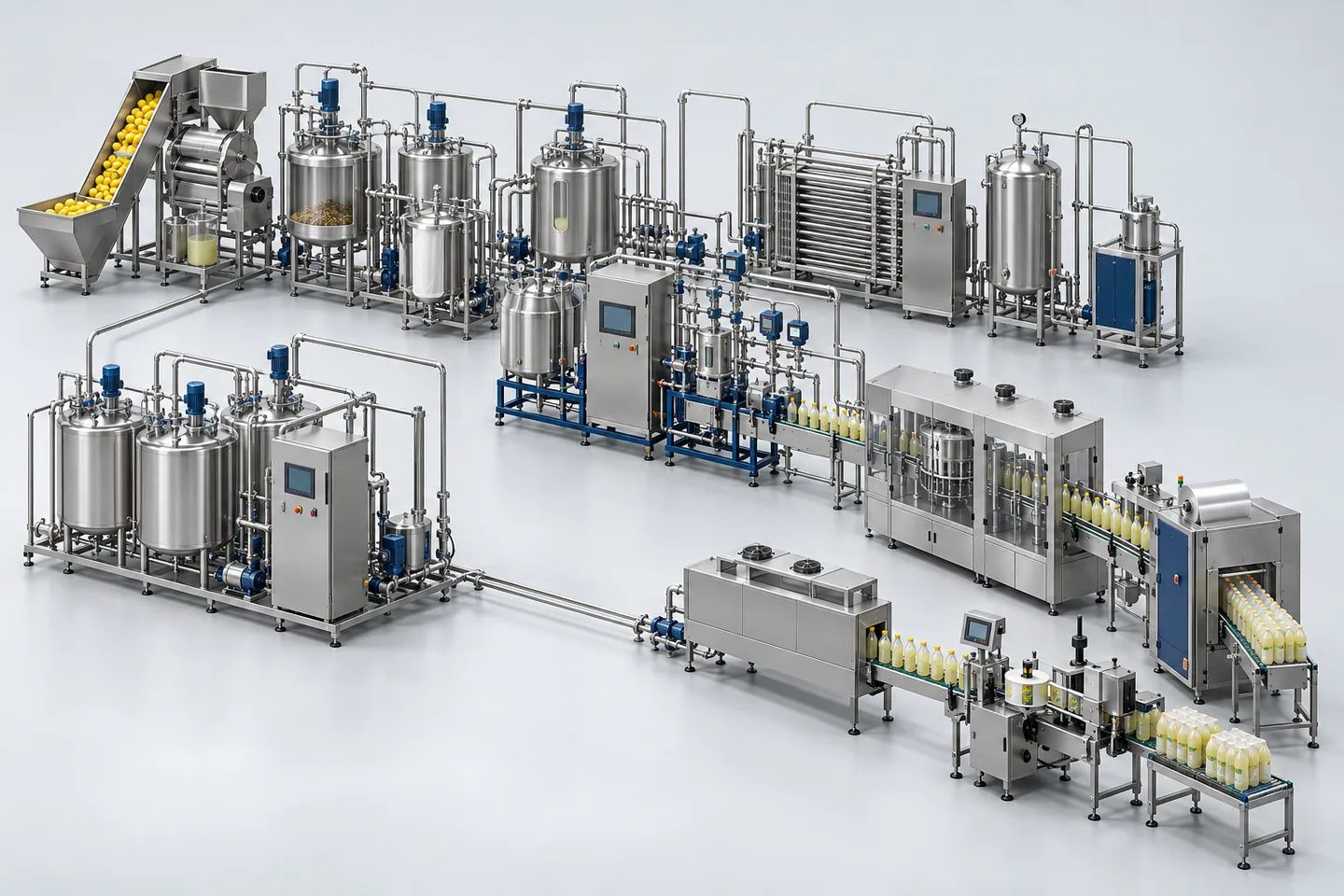
A turnkey lemonade and shikanji plant with lemon extraction or concentrate dosing, spice infusion, blending, pasteurisation and PET, glass or pouch filling.
Shikanji and nimbu pani are among the largest-volume beverages consumed in North India and among the smallest in packaged share — the format is still dominated by unbranded street preparation. That gap is the opportunity. The line is deliberately simple and low-capex: lemon juice comes from a citrus extractor or from bought-in concentrate, spice and salt infusions are prepared in a jacketed kettle and filtered, blending is recipe-driven from a PLC, and the product is hot-filled or lightly carbonated depending on your positioning. Because the sugar and acid levels do most of the preservation work, ambient shelf life of 6–9 months is achievable without aseptic capex.
Who this configuration suits.
Get a detailed quote for the Lemonade / Shikanji Plant.
Layout drawing, utility schedule, BIS / FSSAI checklist, itemised quotation in 24 hours.
Everything we ship with this plant.
Standard turnkey scope. Optional add-ons quoted on request.
Specs at a glance.
| Capacity | 1,000 – 6,000 litres/hour |
| Products | Shikanji, nimbu pani, masala lemon, jal-jeera, lemonade |
| Carbonation | Still or 1.5–2.5 volumes CO₂ (optional) |
| Brix range | 8 – 12 °Bx |
| Shelf life | 6–9 months ambient |
| Pack formats | 200ml, 250ml, 300ml, 600ml PET / glass / pouch |
| Power load | 45–90 kW |
| Footprint | 3,000–5,500 sq.ft. |
| Manpower | 8–14 per shift |
What does a lemonade / shikanji plant cost?
A Lemonade, Shikanji & Nimbu Pani Bottling Plant costs ₹45–90 lakh turnkey in India as an indicative range. Final pricing depends on your feedwater analysis, whether the scope is turnkey or machinery-only, your SKU mix and the utilities already on site.
Indicative market range for a turnkey line, not a quotation. The figure moves with feedwater quality, whether the scope is machinery-only or turnkey, how many SKUs you run and what utilities already exist on site.
Output, degree of automation and whether you need redundancy on critical stations.
A high-TDS, iron-heavy or seasonal input changes the treatment train and its cost materially.
Machinery only, or turnkey with civil drawings, utilities, commissioning and BIS / FSSAI documentation.
Number of SKUs, bottle sizes and how fast you need to switch between them.
Common questions.
Should shikanji be carbonated or still?+
Both sell. Still versions read as traditional and travel better through general trade; lightly carbonated versions compete directly with soft drinks and command modern-trade shelf space. The line supports switching between them with a bypass around the carbonator.
Fresh lemon juice or concentrate?+
Concentrate is more consistent, available year-round and simplifies your costing. Fresh extraction gives a better label story and works well if you are in a citrus belt. Many plants run concentrate as the base and add a fresh-extracted fraction for flavour lift.