Built for the way your line actually runs.
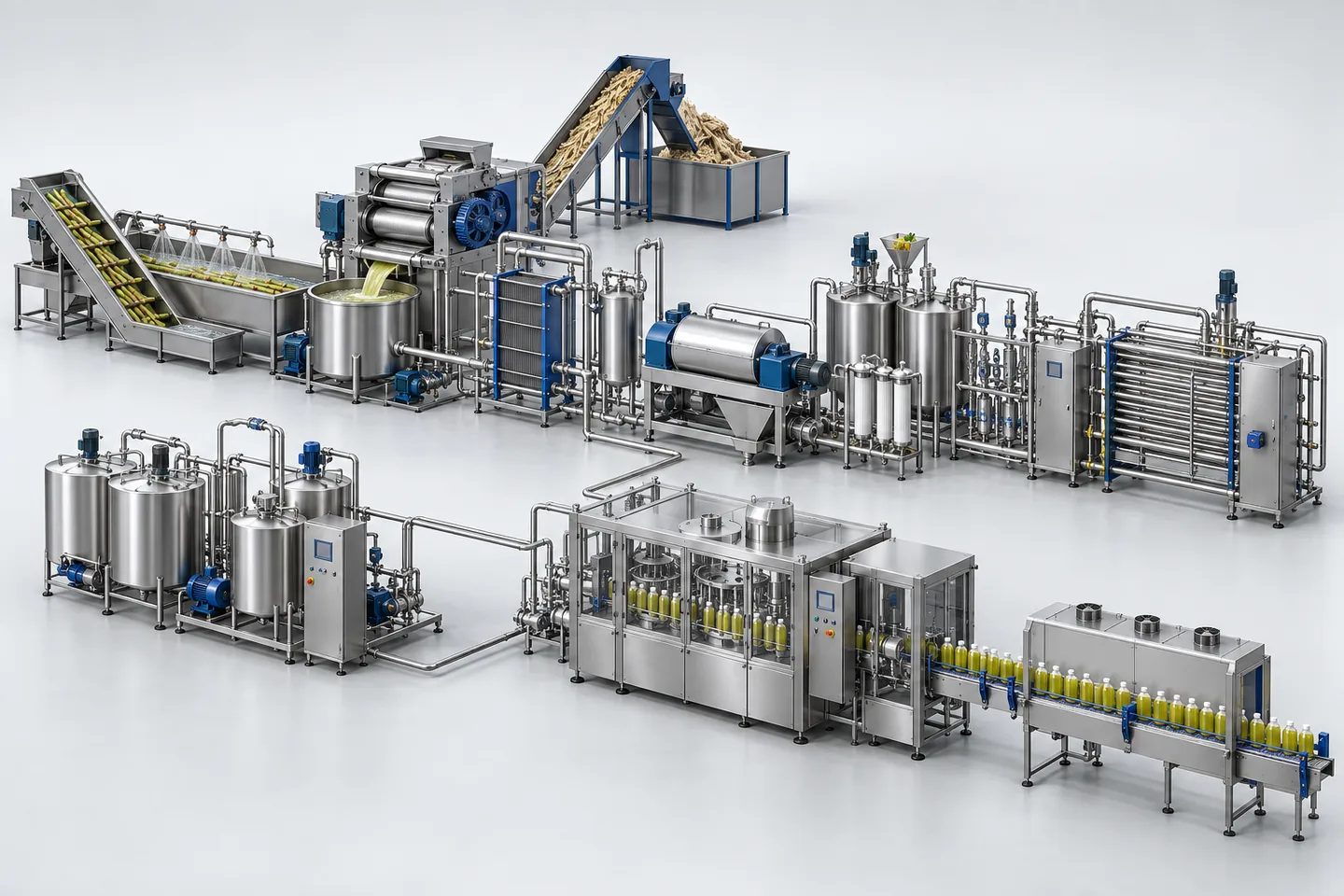
A turnkey sugarcane juice plant with crushing, rapid chilling, enzyme deactivation, clarification and hot-fill or aseptic bottling, producing packaged sugarcane juice with 4–9 months of ambient shelf life.
Sugarcane juice is the hardest common Indian juice to package. Freshly crushed cane browns within minutes through polyphenol oxidase activity, ferments quickly, and carries a heavy suspended-solids load from the cane fibre. Roadside vendors solve this by serving instantly; a packaged product cannot. This line handles it with a compressed process window — cane is crushed, chilled below 5°C within minutes, enzyme-deactivated by a short high-temperature hold, clarified through a decanter and polishing filter, acidity-corrected with lime or ginger extract, and hot-filled or aseptically filled. The result holds colour and flavour through ambient distribution instead of turning grey on the shelf.
Who this configuration suits.
Get a detailed quote for the Sugarcane Juice Plant.
Layout drawing, utility schedule, BIS / FSSAI checklist, itemised quotation in 24 hours.
Everything we ship with this plant.
Standard turnkey scope. Optional add-ons quoted on request.
Specs at a glance.
| Capacity | 1,000 – 5,000 litres/hour juice |
| Cane throughput | 2 – 10 tonnes/hour |
| Juice recovery | 55 – 65% by cane weight |
| Crush-to-chill window | Under 5 minutes |
| Shelf life | 4–6 months hot-fill, 6–9 months aseptic |
| Pack formats | 200ml, 250ml, 300ml PET / glass / can |
| Power load | 90–160 kW |
| Steam | 600–1,200 kg/h |
| Footprint | 6,000–10,000 sq.ft. incl. cane yard |
| Manpower | 12–18 per shift |
What does a sugarcane juice plant cost?
A Sugarcane Juice Processing & Bottling Plant costs ₹90 lakh – ₹2.2 crore turnkey, incl. cane handling in India as an indicative range. Final pricing depends on your feedwater analysis, whether the scope is turnkey or machinery-only, your SKU mix and the utilities already on site.
Indicative market range for a turnkey line, not a quotation. The figure moves with feedwater quality, whether the scope is machinery-only or turnkey, how many SKUs you run and what utilities already exist on site.
Output, degree of automation and whether you need redundancy on critical stations.
A high-TDS, iron-heavy or seasonal input changes the treatment train and its cost materially.
Machinery only, or turnkey with civil drawings, utilities, commissioning and BIS / FSSAI documentation.
Number of SKUs, bottle sizes and how fast you need to switch between them.
Common questions.
Why does packaged sugarcane juice turn grey or brown?+
Polyphenol oxidase in the cane reacts with oxygen almost immediately after crushing. If juice is not chilled and enzyme-deactivated inside a few minutes, browning is already locked in before pasteurisation. Our line is built around that time window, which is why crushing sits directly next to the chiller.
Is sugarcane juice seasonal?+
Cane availability is seasonal in most belts, typically November to April in North India. Plants either run a seasonal campaign, buy in cane from staggered geographies, or use the same line for other fruit during the off-season — which we design for from the start.