Built for the way your line actually runs.
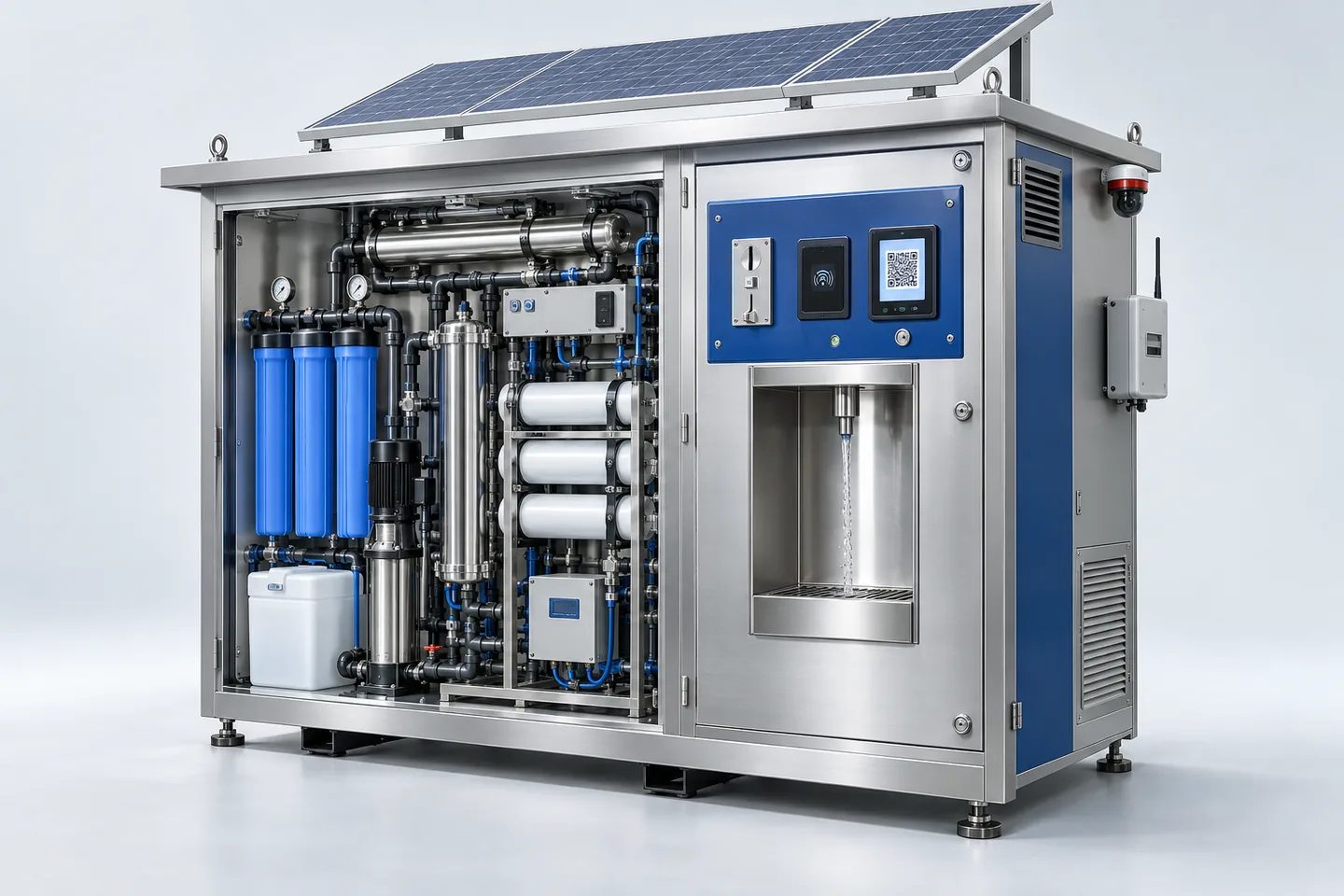
A standalone RO-based water ATM with metered dispensing, coin / RFID card / UPI payment options, remote monitoring and tamper-resistant enclosure, for community and municipal water supply projects.
Water ATMs solve a different problem from bottling: delivering safe water at the lowest possible per-litre cost, with zero packaging. They are widely deployed by municipal bodies, railway stations, bus terminals, panchayats, industrial townships and CSR programmes. The unit carries its own RO train, UV disinfection and chilled-water option, and dispenses metered volumes against a coin, RFID card or UPI transaction. Remote telemetry reports flow totals, TDS, filter life and fault states to a dashboard, so an operator running fifty units across a district knows which one needs a service visit before the complaints start.
Who this configuration suits.
Get a detailed quote for the Water ATM.
Layout drawing, utility schedule, BIS / FSSAI checklist, itemised quotation in 24 hours.
Everything we ship with this plant.
Standard turnkey scope. Optional add-ons quoted on request.
Specs at a glance.
| Dispensing capacity | 250 – 1,000 LPH |
| Payment modes | Coin, RFID card, UPI QR, free-mode |
| Dispense volumes | 300ml, 500ml, 1L, 5L, 20L presets |
| Monitoring | GSM / LoRa telemetry with cloud dashboard |
| Power load | 1.5 – 4 kW (solar option available) |
| Footprint | 25 – 60 sq.ft. |
| Enclosure | IP-rated, tamper-resistant, outdoor-grade |
| Chilling | Optional 40–100 LPH chilled output |
What does a water atm cost?
A Water ATM / Bulk Water Dispensing Unit costs ₹3–8 lakh per unit in India as an indicative range. Final pricing depends on your feedwater analysis, whether the scope is turnkey or machinery-only, your SKU mix and the utilities already on site.
Indicative market range for a turnkey line, not a quotation. The figure moves with feedwater quality, whether the scope is machinery-only or turnkey, how many SKUs you run and what utilities already exist on site.
Output, degree of automation and whether you need redundancy on critical stations.
A high-TDS, iron-heavy or seasonal input changes the treatment train and its cost materially.
Machinery only, or turnkey with civil drawings, utilities, commissioning and BIS / FSSAI documentation.
Number of SKUs, bottle sizes and how fast you need to switch between them.
Common questions.
Can water ATMs be run on a revenue-share model?+
Yes, and most district-scale deployments are. Telemetry gives you auditable per-unit dispensing and revenue totals, which is what makes revenue-share or municipal concession agreements workable.
What maintenance does a water ATM need?+
Pre-filter changes every 4–8 weeks, RO membrane inspection quarterly, UV lamp annually, plus a sanitisation cycle. The dashboard flags each of these by running hours rather than by calendar, which cuts unnecessary site visits.